
Indigenous Approaches to Knowledge
The Seven Sacred Grandfather Teachings
Benton-Banai was Ojibwe-Anishinabe of the Fish Clan from Lac Courte Oreilles Reservation in Northern Wisconsin. In 1988 Benton-Banai became grand chief of the Three Fires Midewiwin Lodge.
This link leads to a shortened version of the teachings as recounted by Benton-Banai (1988).
See also: Seven Sacred Grandfather Teachings – this video is the creation of Ojibwe Hip Hop artist Thomas X. https://youtu.be/ZGh1BXrf_Os
Shkaabe Makwa
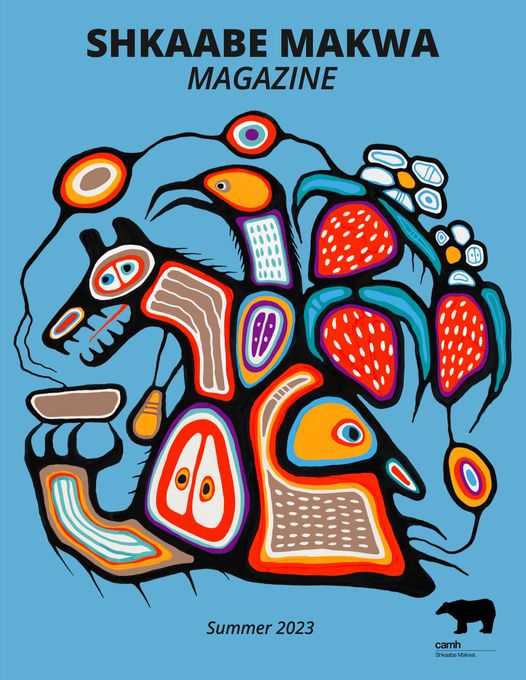
Shkaabe Makwa translates to “Spirit Bear Helper.” This Toronto organization is the first hospital-based Centre in Canada designed to drive culturally-responsive systems initiatives to achieve health, justice, and wellness for First Nations, Inuit and Métis communities through the advancement of research, workforce development and innovative healing models that harmonize traditional knowledge and medical expertise.
You can join their mailing list, like their Facebook page, and now read their online magazine.
pihtikwê: Visits with First Nations Psychologists Podcast
pihtikwê means “come on in”, “welcome” in Cree
With topics like Winning Trust in Children and Communities, Culturally Based Means We Start from Culture First, and Be Courageous. Be Strategic. Be More Resistant, this podcast series was developed by the Healing from Trauma and Reducing Addictions group, part of the Ontario Network Environments Indigenous Health Research (ON NEIHR) Program.
Research
Queen’s Open Access course on Indigenous Community Research Partnerships
A 4-module self paced online training course designed to assist researchers who are new to research in partnerships with Inuit, Métis and First Nations (Indigenous) communities, or who are researchers-in-training.
Tri-Council Policy Statement (TCPS2) Chapter 9
The Tri-Council Policy Statement (TCPS2) is a Canadian guideline for the ethical conduct of research involving humans and/or human biological materials. In the 40s and 50s in Canada, Indigenous people were subjected to unethical studies for which no consent was obtained; but even after that era, studies were done about Indigenous people in which they had little say, and which failed to benefit them in any way. Chapter 9 sets out a framework to prevent this from happening.
Indigenous Peoples Atlas of Canada
The Royal Canadian Geographical Society, in partnership with Canada’s national Indigenous organizations, has created a groundbreaking four-volume atlas that shares the experiences, perspectives, and histories of First Nations, Inuit and Métis peoples. It’s an ambitious and unprecedented project inspired by the Truth and Reconciliation Commission’s Calls to Action. Exploring themes of language, demographics, economy, environment and culture, with in-depth coverage of treaties and residential schools, these are stories of the Indigenous Peoples of Canada, told in detailed maps and rich narratives. This website from Canadian Geographic also has excellent information.
The Kairos Blanket Exercise
The KAIROS Blanket Exercise is a program of KAIROS CANADA. KAIROS Canada is an ecumenical movement for ecological justice and human rights around the globe. https://www.youtube.com/watch?v=KzXdi_RDkjc
Indigenous Health: A Walrus magazine podcast
What must change to promote greater health equity among Indigenous peoples in Canada? First Nations, Métis, and Inuit peoples in Canada face significant health disparities compared with non-Indigenous Canadians in nearly all areas of medical care.
This podcast brings together four speakers, including Thunderbird’s CEO Dr. Carol Hopkins, to examine some of the key components of much needed change.
Indigenous Graduate Education in Nursing – BC
The IGEN Project is an Indigenous-led collaborative of diverse people and institutions, Indigenous communities, and supporters seeking to collaboratively develop, implement and evaluate an Indigenous Master of Nursing education specialty stream for Indigenous nurses and nurses working with Indigenous People in British Columbia. See a video about it here.

Braiding Sweetgrass: Indigenous Wisdom, Scientific Knowledge, and the Teachings of Plants
Braiding Sweetgrass, by Robin Wall Kimmerer, is a New York Times Bestseller and a Washington Post bestseller named “Best Essay Collection of the Decade” by Literary Hub. As a botanist, Robin Wall Kimmerer has been trained to ask questions of nature with the tools of science. As a member of the Citizen Potawatomi Nation, she embraces the notion that plants and animals are our oldest teachers. In Braiding Sweetgrass, Kimmerer brings these two lenses of knowledge together.
Indigenous Knowledge and Western Science
Dr. Leroy Little Bear speaks at an event at the Banff Centre: https://www.youtube.com/watch?v=gJSJ28eEUjI
Aboriginal Healing Foundation
AHF publications at this link.
Residential Schools
Shattering the Silence: The Hidden History of Indian Residential Schools in Saskatchewan
This ebook for educators is a free ebook you can download on your device. It contains a wealth of resources for adults, youth, children and students, links to professional development, curricular connections and inquiry starters. Although focused on Saskatchewan, resources and understandings presented are universal.
Also see the Residential Schools webpage.
Indigenous Stories
Indigenous Storywork: Educating the Heart, Mind, Body and Spirit by Jo-ann Archibald aka Q’um Q’um Xiiem. For many Indigenous peoples, stories are a key teaching tool. Stories also have a potentially wide range of roles to play in research. This book outlines those roles and advises on how stories can be used effectively and ethically, using the seven principles of storywork: ‘respect, responsibility, reciprocity, reverence, holism, inter-relatedness, and synergy’
Library and Archives Canada Indigenous Heritage Webpage
Mino Bimaadiziwin Podcasts
These podcasts cover subjects ranging from systemic racism in health care to Indigenous mental health and cultural approaches to transforming health care and treating addictions. Go to the latest episodes at this link.
Videos
- The Unforgotten: A five-part film exploring the health and well-being of Indigenous peoples living in Canada
- ‘The Eyes of Children’ — life at a residential school | CBC
Christmastime at a residential school in British Columbia in 1962. - We were children | NFB
In this feature film, the profound impact of the Canadian government’s residential school system is conveyed through the eyes of two children who were forced to face hardships beyond their years. - In Jesus’ Name: Shattering the Silence of St. Anne’s Residential School | Susan G. Enberg Productions
A poignant all-Indigenous English and Cree-English collaborative documentary film that breaks long-held silences imposed upon indigenous children who were interned at the notoriously violent St. Anne’s Residential School in Fort Albany First Nation, Ontario. - Sleeping Children Awake | Magic Arrow Productions
Sleeping Children Awake is one of the earliest independent, feature length documentaries to broadcast on the Residential School System. It won several awards including “Best Canadian Documentary 1993.” - The Ghosts of Camsell – Edmonton Museum Project. The Charles Camsell Hospital was a perfect intersection – and perfect storm – of colonial health policies, aviation, the North, medical history, and residential schools. Although the hospital was intended to treat Indigenous people with tuberculosis, it was also a site where Native Americans were involuntarily sterilized and subjected to research to which they did not consent.
 kā-wīci-pimohtēmāt Professional Practice Group